Boston Municipal Court History: From Its 1866 Founding to Eight Divisions Today
Updated: 13 hours ago
Boston Municipal Court: A Court Shaped by Boston’s History
The Boston Municipal Court (BMC) is a department of the Massachusetts Trial Court, not simply the name of a courthouse building. Today it operates through eight divisions and hears a broad range of criminal, civil, and other matters authorized by law. Its history reflects the growth of Boston and the changing structure of Massachusetts courts.
For someone navigating the judicial system, the most important distinctions are between a court department, an individual division, a courthouse building, and a particular type of proceeding. This guide explains those distinctions while tracing the BMC’s origins, institutional changes, locations, jurisdiction, and public services. For the steps in an ordinary civil case, see our Massachusetts civil litigation guide.
The Road to the 1866 Establishment
Boston had municipal judicial institutions long before the modern BMC was created. A Municipal Court of the Town of Boston existed in 1799, and changes followed Boston’s incorporation as a city in 1822. The establishment of the Superior Court system in 1859 also affected the organization of local courts. Those earlier institutions should not automatically be treated as the same continuous court as the BMC operating today.
The key legislative milestone for the modern BMC was Chapter 279 of the Acts of 1866, establishing the Municipal Court of the City of Boston. Over time, the court’s organization, facilities, and jurisdiction evolved. Anyone researching an old case should verify the exact historical court name and the applicable statute rather than assume that a familiar modern name identifies the same institution in every period.
The court developed as Boston’s population, commerce, and demand for local judicial services increased. Although the issues facing litigants have changed, the underlying importance of formal process remains. A person receiving a civil subpoena today still needs to understand what the issuing court actually requires.
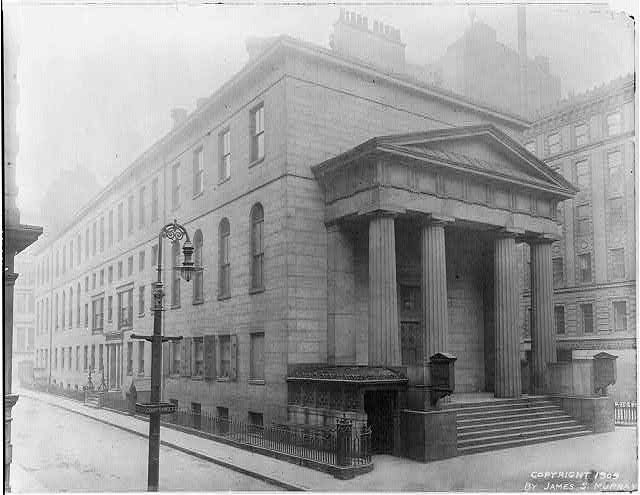
Old Suffolk County courthouse at Court Street and Court Square, circa 1909; this is not identified as the original 1866 BMC courthouse.
The 1978 Reorganization and the Eight-Division Court
Chapter 478 of the Acts of 1978 reorganized the Massachusetts trial courts into a unified system. The BMC became a department of the statewide Trial Court alongside the Superior Court, District Court, Housing Court, Probate and Family Court, and other departments. Its historic name remained, but its status is that of a Massachusetts state court.
A further organizational change took place around 2004, when the BMC expanded from a principally downtown institution to its present eight-division structure. The date of the 1866 founding does not mean that all eight courthouses opened then or that their geographical boundaries have remained unchanged. Court history and the history of each building are distinct subjects.
The Central Division and Edward W. Brooke Courthouse
The BMC Central Division sits in the Edward W. Brooke Courthouse at 24 New Chardon Street, Boston, MA 02114. Its listed telephone number is 617-788-8600. The courthouse is also used for other judicial functions, so the building name alone does not identify every proceeding held there. The official Central Division page provides current court information and visitor resources.
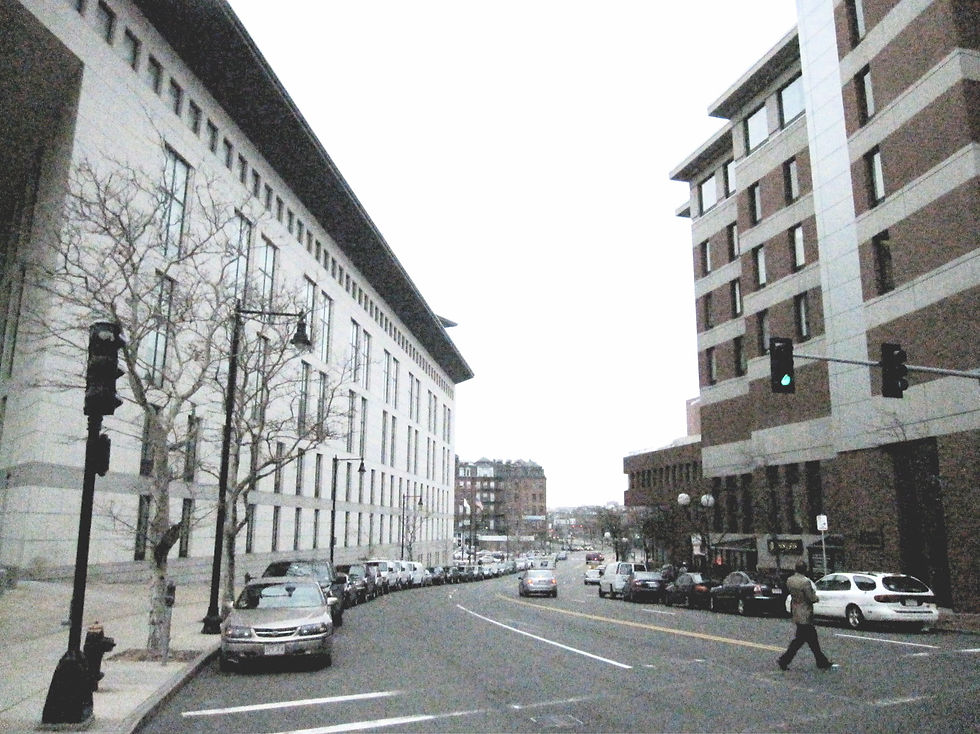
The courthouse area on New Chardon Street, photographed in 2010.
The Brooke Courthouse opened in 1999, long after the BMC was established. The year a court department was founded must not be confused with the year its current building was constructed. For historical facilities information, consult the Massachusetts Trial Court capital projects record.
The Eight BMC Divisions and the Communities They Serve
The eight divisions are Central, Brighton, Charlestown, Dorchester, East Boston, Roxbury, South Boston, and West Roxbury. The Central Division serves downtown Boston and several surrounding neighborhoods, including Chinatown, the North End, West End, Beacon Hill, and portions of the South End. Brighton primarily serves Allston and Brighton, while Charlestown, Dorchester, Roxbury, and South Boston generally serve their respective areas.

Boston's skyline viewed across the harbor.
The East Boston Division also covers Winthrop, Logan Airport, and the Sumner and Callahan tunnels. The West Roxbury Division covers West Roxbury, Hyde Park, Roslindale, Jamaica Plain, and portions of Mattapan and Mission Hill. Legal boundaries do not always correspond exactly to ZIP codes or colloquial neighborhood names. Check the official BMC division directory when location matters.
The current listed locations include Brighton at 52 Academy Hill Road; Central at 24 New Chardon Street; Charlestown at 3 City Square; Dorchester at 510 Washington Street; East Boston at 37 Meridian Street; Roxbury at 85 Warren Street; South Boston at 535 East Broadway; and West Roxbury at 445 Arborway in Jamaica Plain. Confirm the relevant division and address against your court notice before traveling.
Clerk’s office telephone numbers (verify current details before calling): Brighton 617-782-6540; Central 617-788-8600; Charlestown 617-242-5400; Dorchester 617-288-9500; East Boston 617-569-7550; Roxbury 617-427-7000; South Boston 617-268-9292; West Roxbury 617-971-1200. Consult the official Massachusetts court directory for each division’s current address and contact information.
How Courthouse Addresses Change Over Time
The BMC’s institutional history is not the same as the history of its buildings. For example, a 2011 Massachusetts Trial Court relocation report listed the Charlestown Division at 2 City Square, while the current court directory lists 3 City Square. That difference shows why researchers should identify the date of an address record, but it does not by itself establish when or why a relocation occurred.
The 2011 Trial Court relocation report also documents facilities associated with the Brooke Courthouse. Reliable historical research may require archived directories, annual reports, legislative materials, and building records. A former courthouse address should never be substituted for a current summons or hearing notice.
Criminal Jurisdiction: More Than Minor Offenses
The BMC hears many misdemeanors and certain felonies within the authority granted by Massachusetts law. Under Massachusetts General Laws chapter 218, section 26, criminal jurisdiction for the BMC and District Court is defined by statute. It is inaccurate to assume that every felony must begin or be tried in Superior Court, or that the BMC handles only trivial violations.
A criminal matter may involve a summons, arraignment, bail, discovery, motions, pretrial proceedings, and trial. Certain allegations may first be considered at a clerk-magistrate hearing. The nature of that proceeding matters because a preliminary hearing is not necessarily equivalent to a formally commenced criminal prosecution.
Procedural rules in effect today govern contemporary cases, regardless of the historical age of the courthouse. A reader comparing litigation procedures may also review our explanation of depositions and witness preparation, while remembering that civil and criminal discovery follow different rules.
Civil Jurisdiction: Contracts, Torts, and Monetary Claims
The BMC also hears contract, tort, and other civil matters falling within its statutory authority. For certain actions filed on or after January 1, 2020, the court’s published guidance identifies $50,000 in reasonably anticipated recovery as an important jurisdictional benchmark. The nature of the claim and any applicable exceptions still matter.
Ordinary civil litigation can involve a complaint, service of process, an answer, discovery, motions, and potentially trial. Our civil litigation overview explains the sequence, while the deposition preparation guide discusses one important discovery method.
Receiving court papers does not automatically make a person a defendant. A subpoena for testimony or records may be directed to a nonparty. The obligations depend on the document, the issuing authority, proper service, and the relevant deadline.
Small Claims, Housing Disputes, and Specialized Matters
The small claims procedure generally applies to disputes of up to $7,000, subject to statutory exceptions. It is intended to be more accessible than ordinary civil litigation, but parties still must follow applicable deadlines, present evidence, and understand available review procedures. More complex disputes may require ordinary civil procedure.
The BMC can also hear certain landlord-tenant and possession disputes, while the Housing Court is a specialized department with overlapping responsibilities in some matters. Depending on the statute, the BMC may also address certain protective orders, mental-health proceedings, and judicial review of particular administrative decisions. A courthouse shared by multiple departments does not make their procedural rules interchangeable.
Choosing the Correct Division and Preparing for Court
Begin by identifying the type of case and the court department authorized to hear it. Next, determine the proper geographical division or venue, taking account of the alleged offense, the parties, and any special venue rule. Finally, check the specific hearing notice. The official BMC jurisdiction guidance is a useful starting point, but it does not replace legal analysis for a particular case.
Before appearing, verify the hearing date, courthouse entrance, courtroom, and whether remote participation is permitted. The court also provides information about public records, forms, interpreter services, accessibility, and fee-related procedures. See the BMC official homepage for current resources.
Organizing documents by date and issue can help a person understand the proceeding. The preparation needed for civil litigation, subpoena compliance, and depositions is not identical. Different procedures create different responsibilities.
Why the BMC’s History Still Matters
The BMC’s story runs from its 1866 statutory establishment through the 1978 statewide reorganization and the expansion of its division structure around 2004. These changes reflect shifting judicial needs, administrative arrangements, courthouse facilities, and neighborhood service areas. Understanding that history helps explain why a court can have a long institutional lineage while occupying a comparatively modern building.
For anyone involved in a present-day case, historical context is useful, but current statutes, court rules, and case-specific notices control the actual process. Readers may continue with our guides to Massachusetts civil litigation, discovery and depositions, and clerk-magistrate hearings for more on the proceedings mentioned here.
Legal Disclaimer. Originally published: 10/10/2026. This article provides general information only and is not legal advice for any particular matter. Laws, policies, procedures, fees and agency practices may change; their application depends on the facts and jurisdiction. Consult a qualified attorney about your circumstances before acting on this information. Reading this article or contacting Blumsack & Canzano does not, by itself, create an attorney-client relationship. Past results do not guarantee future outcomes. This material may be considered attorney advertising in some jurisdictions.