
A Pending U Visa Does Not Guarantee a Continuance: L. Ramirez Explained
A potentially viable U-visa petition can matter in removal proceedings without entitling the respondent to wait indefinitely for USCIS. In this October 16, 2026 precedent, the Board of Immigration Appeals applied the general good-cause framework for continuances and overruled Matter of Sanchez Sosa’s presumption favoring a continuance for a prima facie approvable U-visa petition. It dismissed the respondent’s appeal.
Read the official decision: Matter of L. Ramirez, 30 I&N Dec. 157 (BIA 2026).
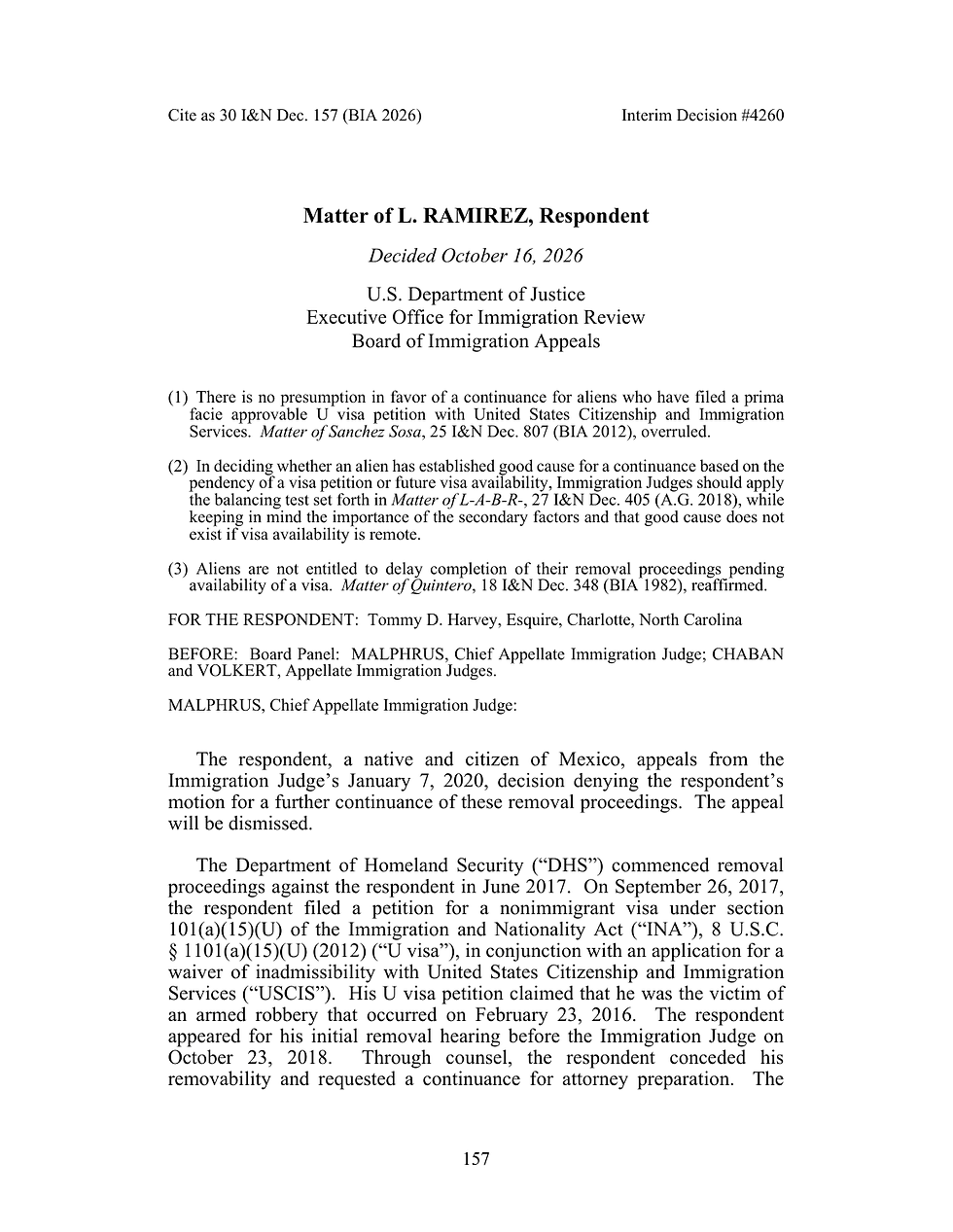
A collateral application with no concrete completion date
The respondent filed a U-visa petition and waiver application in September 2017, based on an alleged armed robbery in February 2016. Removal proceedings had begun in June 2017. After preparation time and a later continuance to await USCIS, the immigration judge denied a further request in January 2020. The judge had warned that the case would not remain pending indefinitely. By the Board’s 2026 decision, the record still did not show adjudication of the petition. See pages 157–159.
The general good-cause analysis now governs
Under 8 C.F.R. § 1003.29 and Matter of L-A-B-R-, the principal considerations are the likelihood of obtaining the collateral relief and whether that relief would materially affect the removal proceedings. Other relevant considerations include diligence, DHS’s position, the requested delay, and the procedural history. The analysis weighs these circumstances together; favorable primary considerations do not automatically require another continuance.
At pages 159–161, the Board concluded that U-visa cases should not receive a separate presumption based on prima facie approvability. It overruled Sanchez Sosa to that extent. The holding changes the decisional framework; it does not categorically prohibit continuances whenever a U petition is pending.
Why a plausible petition was not enough here
Even assuming the U petition and waiver met the relevant preliminary showing, the secondary considerations weighed against further delay. The Board emphasized the indefinite adjudication horizon, DHS’s opposition, and the unexplained interval of roughly eighteen months between the alleged crime and filing. The prospect of collateral relief was too remote to require the requested delay on this record.
The Board also reaffirmed that a respondent is not entitled to keep removal proceedings open until a visa becomes available. References in the opinion to earlier processing expectations describe this case’s history; they should not be read as current estimates for USCIS processing or visa availability.
What was—and was not—decided
The Board upheld the denial of a continuance and dismissed the appeal, leaving the immigration judge’s removal order in place. It did not adjudicate the merits of the U petition, which falls within USCIS’s authority. A procedural denial of additional court time is distinct from a USCIS denial of the collateral benefit.
Evidence a continuance request should address
A useful request explains the petition’s procedural status, the basis for likely eligibility, the effect of a favorable outcome, and why the particular delay requested is justified. Receipts alone may establish that a filing exists without answering those questions. The submission should also document diligence, explain prior delays, and confront the hearing history. Counsel must assess any applicable circuit authority and later developments rather than assume that a prima facie U case creates an automatic right to wait.
Legal Disclaimer. Originally published: 11/01/2026. This article provides general information only and is not legal advice for any particular matter. Laws, policies, procedures, fees and agency practices may change; their application depends on the facts and jurisdiction. Consult a qualified attorney about your circumstances before acting on this information. Reading this article or contacting Blumsack & Canzano does not, by itself, create an attorney-client relationship. Past results do not guarantee future outcomes. This material may be considered attorney advertising in some jurisdictions.


