
Three EB-1A Criteria Met, but No Approval Yet: A Medical Scientist’s Remand
A successful challenge to an EB-1A denial may change which criteria are satisfied without producing an immediate approval. In In Re: 43921798, the AAO accepted evidence of judging, published material about the petitioner, and scholarly authorship. At the same time, it withdrew USCIS’s favorable finding on a leading or critical role. The revised count still satisfied three initial criteria, but the AAO remanded for an overall merits assessment rather than deciding extraordinary ability in the first instance.
The August 25, 2026 nonprecedent decision concerned a medical scientist working in health economics and outcomes research. Its procedural result was a withdrawn denial and a new adjudication, with no opinion expressed about the ultimate outcome on remand.
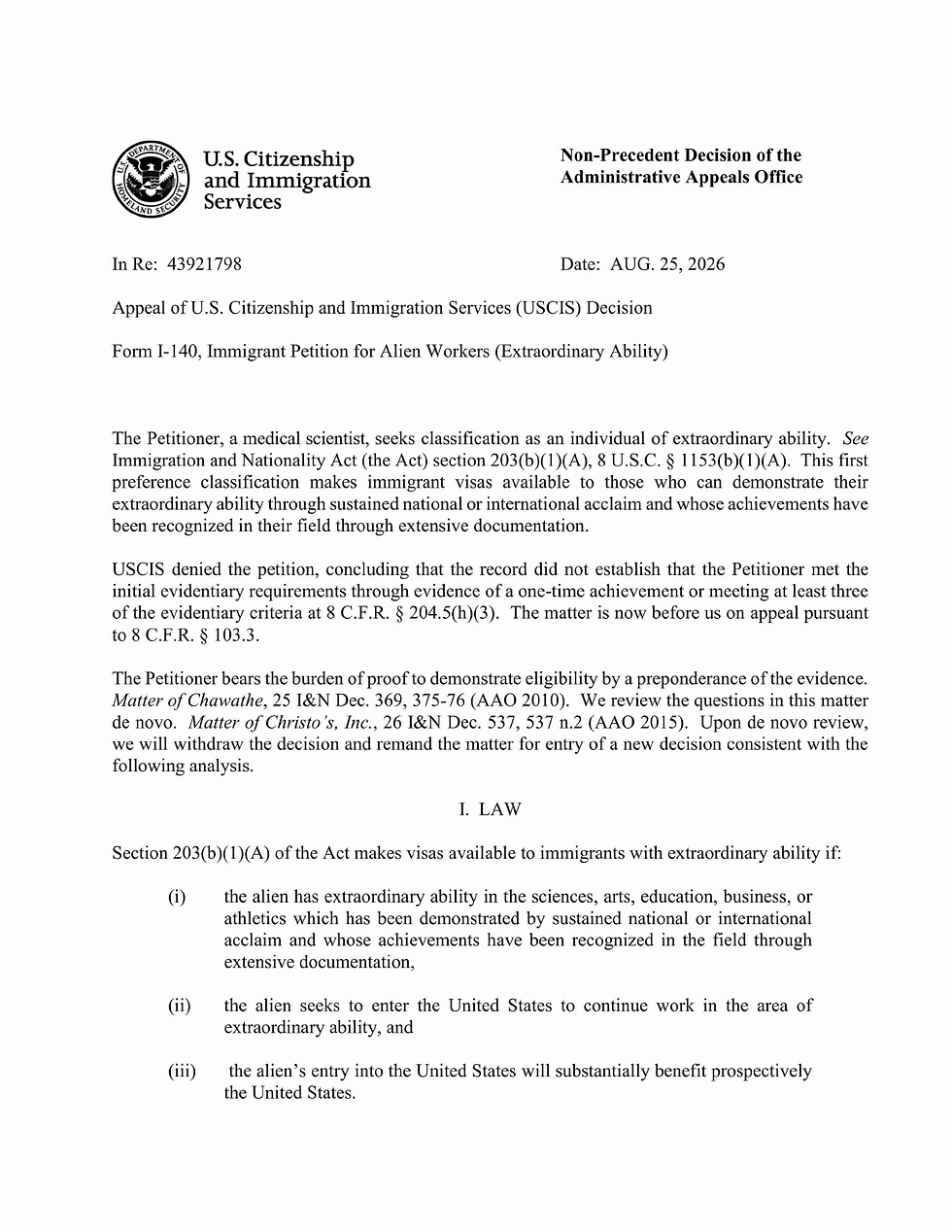
What the initial review had accepted and rejected
The petitioner worked in global real-world evidence in immunology, combining epidemiology, health economics, and biostatistics to evaluate therapies in routine care. USCIS accepted judging and a leading or critical role but rejected the other three claimed criteria: published material, original contributions, and scholarly authorship. The AAO reviewed the record de novo. See pages 2–3.
Professional publications supported two additional criteria
A Managed Healthcare Executive article was about the petitioner and her work, included the required identifying information, and appeared in a publication documented as serving healthcare executives. The AAO disagreed with USCIS’s rejection of that evidence. See page 4.
For scholarly authorship, the AAO accepted a research article in the Journal of Managed Care + Specialty Pharmacy. Evidence about the journal’s professional readership—including pharmacists, physicians, nurses, and other health-management professionals—addressed the nature of the publication. The AAO concluded that the criterion was satisfied rather than requiring circulation figures as the only possible proof. See pages 4–5.
Journal correspondence also supported the already accepted judging criterion by confirming manuscript reviews. Thus, judging, published material, and scholarly authorship supplied the three initial criteria identified by the AAO.
Why the AAO withdrew the role finding
USCIS had accepted the role criterion without an explanation. A supervisor described responsibilities and research projects, including a study involving outpatient treatment and remote monitoring, but the AAO found insufficient specific evidence of the role’s significance to organizational or departmental outcomes. A $180,000 salary and potential bonuses did not establish that connection without an explanation and supporting evidence. See pages 3–4.
The relevant language in 8 C.F.R. § 204.5(h)(3)(viii) concerns “a leading or critical role for organizations or establishments that have a distinguished reputation.” A managerial title and valued work were not treated as conclusive proof of the claimed role. De novo review could therefore remove a favorable finding as well as correct unfavorable ones.
The remaining question was final merits
Having found three initial criteria, the AAO directed USCIS to evaluate the total record for sustained national or international acclaim and standing at the top of the field under the framework applied in the decision. It instructed that potentially relevant evidence be considered even if it did not fit an individual criterion. The petitioner still bore the burden of explaining its significance. See pages 5–6.
The AAO also rejected the petitioner’s reliance on Mukherji to avoid final merits and explained its position concerning district-court authority. This article reports that agency reasoning; it does not establish the present reach of a particular court judgment, injunction, or later judicial development in another case.
What the remand means for preparation
The order withdrew the denial and remanded. It did not approve the petition, affirm every favorable finding below, or conclude that the original-contributions criterion was met. See page 6. A response on remand should address the actual remaining inquiry with evidence of recognition and the significance of the achievements, while accounting for the withdrawn role finding. Special circumstances, governing court authority, and the complete record require individual review.
Legal Disclaimer. Originally published: 11/01/2026. This article provides general information only and is not legal advice for any particular matter. Laws, policies, procedures, fees and agency practices may change; their application depends on the facts and jurisdiction. Consult a qualified attorney about your circumstances before acting on this information. Reading this article or contacting Blumsack & Canzano does not, by itself, create an attorney-client relationship. Past results do not guarantee future outcomes. This material may be considered attorney advertising in some jurisdictions.


