N-470 and Public Company Nationality: Chawathe | AAO Precedent Series 03
An employee seeking to preserve continuous residence for naturalization through Form N-470 does not always have to identify a public company’s shareholders and prove their nationalities. Chawathe recognizes a specific route: the company must be incorporated in the United States and trade its stock exclusively on U.S. stock markets. An overseas subsidiary’s ownership must still be established separately.
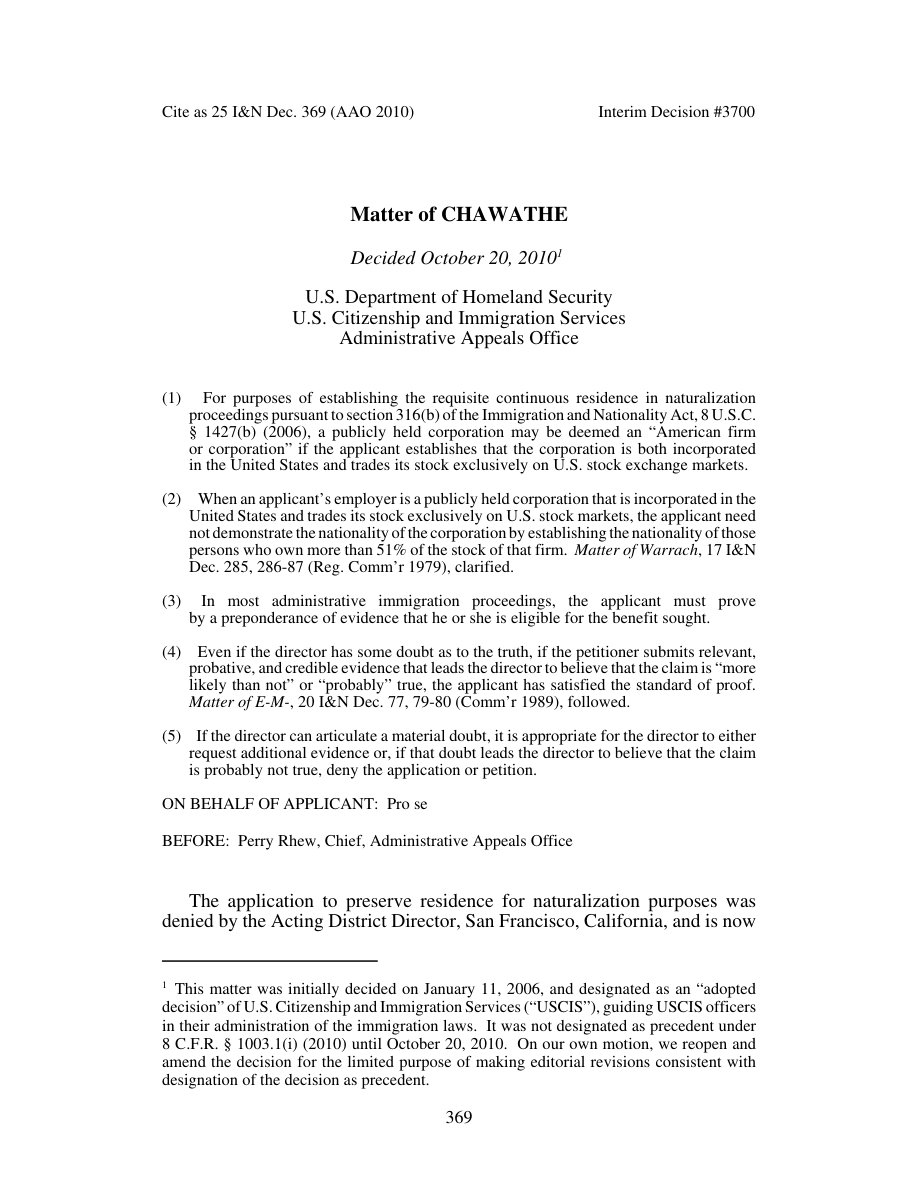
AAO Precedent Series 03 examines Matter of Chawathe, 25 I&N Dec. 369 (AAO 2010). It was designated as precedent on October 20, 2010. Footnote 1 explains that the original decision was issued on January 11, 2006, and reopened in 2010 for editorial revisions associated with precedent designation. Under 8 CFR §103.3(c), designated decisions bind immigration service employees in proceedings involving the same issues, subject to modification or overruling by later precedent.
Why was the employee’s N-470 initially denied?
The applicant worked for ChevronTexaco, became a permanent resident in 2000, and filed Form N-470 in 2003. His proposed assignment was to Saudi Arabian Texaco (SAT) in Kuwait for two to three years. According to the employer’s letter, he would perform the same role as in California and continue receiving his salary from ChevronTexaco. The San Francisco district office denied the application because it found insufficient proof that ChevronTexaco was an American corporation or that SAT was a qualifying subsidiary. The applicant appealed both findings (decision at 370–371, 375).
The dispute concerned corporate ownership. The traditional Warrach analysis traced the nationalities of principal owners; incorporation under a U.S. state’s law alone did not establish an American corporation. Yet identifying the owners and nationalities behind a public company’s frequently traded shares could be extremely difficult. The AAO considered a method suited to that corporate structure.
U.S. incorporation and exclusive U.S. trading must both be shown
ChevronTexaco’s 2002 SEC Form 10-K showed Delaware incorporation and trading on the New York Stock Exchange and the then-existing Pacific Stock Exchange. The AAO found that the company was incorporated in the United States and traded exclusively on U.S. stock markets. It therefore qualified as an American corporation under INA §316(b), without tracing individual shareholders’ nationalities (decision at 372–374). These company names and exchange arrangements describe the historical record.
Footnote 6 at page 374 emphasizes that “both facts must be present.” A company incorporated in the United States but also trading abroad cannot rely on its U.S. listing alone to use this route. If either condition is missing, the applicant must establish the company’s nationality through the Warrach ownership analysis.
Why did the 10-K and employer letter establish subsidiary ownership?
Proving the parent company’s nationality did not resolve the subsidiary issue. INA §316(b), codified at 8 USC §1427(b), addresses an American firm engaged wholly or partly in developing U.S. foreign trade and commerce. Under the subsidiary route, an American firm must own more than 50 percent of the subsidiary’s stock. A qualifying parent does not automatically establish that every affiliate meets this condition.
The 10-K identified SAT as a subsidiary. A letter from the assistant to SAT’s president described it as wholly owned and explained the temporary assignment. The AAO acknowledged that direct stock-ownership records would have been more probative, but found the existing evidence sufficient under the preponderance standard. The 10-K carried substantial credibility; the letter writer’s position supported firsthand knowledge; and the letter was consistent with the 10-K and uncontradicted by other evidence (decision at 375–376).
At page 376, the AAO describes the standard as “more likely than not.” Officers assess relevance, probative value and credibility in the context of the whole record. Document volume alone does not decide the question, and every doubt need not disappear. Footnote 7 at page 375 preserves the applicant’s burden and any basic evidence required by regulation. A different standard specified by law still controls when applicable.
The AAO ultimately found that ChevronTexaco qualified as an American corporation, owned more than 50 percent of SAT, and was making a temporary assignment that furthered foreign trade and commerce. It sustained the appeal and found the applicant eligible to preserve residence (decision at 376–377). That resolved the N-470 application; it was not an approval of naturalization.
Which personal requirements remain after the company qualifies?
For permanent residents considering this employment route today, Chawathe explains how corporate nationality and the record’s evidence can be established. Current §1427(b) and (c) still require an uninterrupted year of physical presence and residence in the United States after admission as a permanent resident, followed by qualifying employment abroad, and proof that the absence serves that qualifying purpose. 8 CFR §316.5(d)(1)(i) permits filing Form N-470 before or after employment begins, but before a continuous absence reaches one year. Personal residence records, filing timing and the actual assignment remain part of eligibility.
For an American-company employee, §316(b) preserves continuous residence; §316(c) does not excuse the ordinary physical-presence requirement for that employment category. Matching incorporation records, the complete range of trading markets, the subsidiary ownership chain and assignment duties to their separate legal conditions shows which facts the evidence supports and where further proof is needed.
Legal Disclaimer. Originally published: 11/14/2026. This article provides general information only and is not legal advice for any particular matter. Laws, policies, procedures, fees and agency practices may change; their application depends on the facts and jurisdiction. Consult a qualified attorney about your circumstances before acting on this information. Reading this article or contacting Blumsack & Canzano does not, by itself, create an attorney-client relationship. Past results do not guarantee future outcomes. This material may be considered attorney advertising in some jurisdictions.


